

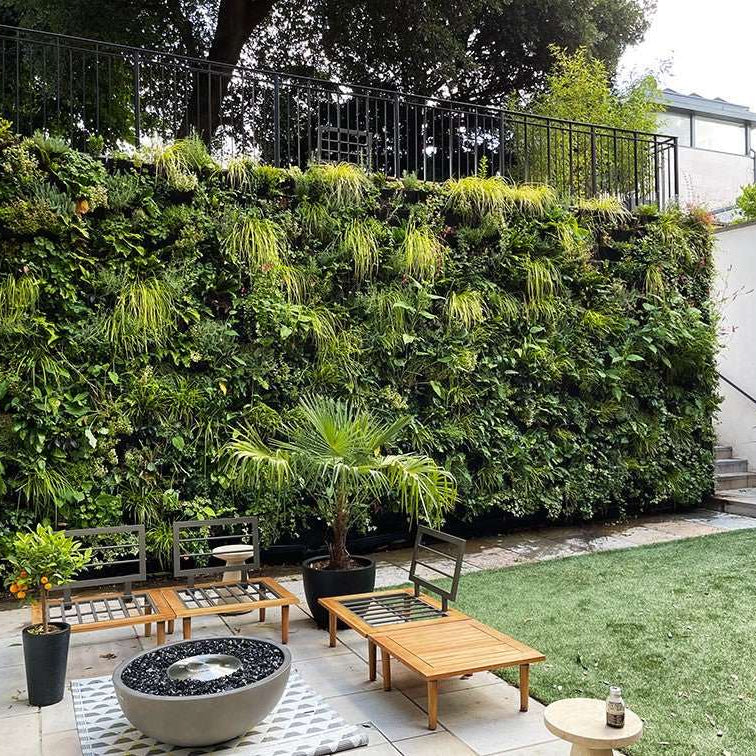



If rabbits keep eating what you plant, it is easy to feel that your choices have narrowed to a handful of things they leave alone. You buy another plant, wait to see what happens, and gradually the garden becomes a collection of experiments. I would approach it differently. Decide what you want the garden to achieve, work out what protection is practical, and then choose a planting palette that suits the whole site.
People often search for “rabbit-proof plants”, but rabbit-resistant is the more useful description. But the right answer is not just a trip to the local garden centre to pick up whatever they have on your list of “rabbit-proof plants”. No, the aim is to reduce the risk of rabbit damage while creating an attractive garden that you can enjoy.

The design principles stay the same
Like all gardens, a garden with rabbits still needs structure, proportion, repetition and interest through the seasons. It needs places to sit, views worth looking at and planting that works with the house and its surroundings. None of those principles changes because rabbits visit.
What changes is how we deliver them. Perhaps the main borders sit inside a protected area, while planting beyond it uses a more restricted palette. Perhaps a new hedge needs its own enclosure, or perhaps using a rabbit deterrent will be enough. Decide these things while planning the garden, so that protection fits the layout from the outset.
The design principles remain the same. Rabbits are one of the conditions that shape the planting palette.
Look at the whole site
Soil type, drainage, sunlight, wind, coastal exposure and available space all matter. A plant that rabbits leave alone is still the wrong choice if it cannot thrive where you put it.
Give each plant a purpose
Think about what it contributes: screening, evergreen structure, ground cover, flowers, movement or winter interest. Then combine plants that work together, with room for their mature size.
Understanding your garden soil is part of that assessment. A sheltered, freely draining border and a windy, wet clay site need different solutions, even when both have rabbits.
Rabbit-proof fencing: the strongest starting point
Where a complete enclosure is feasible, properly installed rabbit fencing is the most dependable foundation. Include gates and the ground beneath them; an unprotected entrance leaves the boundary open.
What does effective fencing involve?
Use wire mesh of about 2.5cm, with fencing 120–140cm high. Bury the bottom 30cm, turning the lower 15cm outwards to discourage digging underneath. Agree the installation detail with your contractor, particularly on uneven or rocky ground.

Check for rabbits already inside before closing an enclosure. Afterwards, inspect the mesh, gate edges and ground line regularly. Where a whole-site enclosure is unrealistic, protect a smaller garden area or selected border instead. Secure wire surrounds can also protect individual plants; avoid loose netting that could entangle wildlife.
Build protection into the garden
A protected planting area can follow the line of a terrace, vegetable garden or main border. Think about gates, access for maintenance and how the fence will look from the house. It is easier to resolve those details on a plan than after everything has been planted.
Do established trees still need protection?
Rabbit damage is not limited to the first year or two. Young trees are especially vulnerable, but older trees can also suffer damage. Being well rooted does not mean the bark is safe. Bark loss around the full circumference of the trunk, known as ringbarking, can kill a tree.
Use appropriate guards or mesh protection where rabbits can reach vulnerable stems. A guard around the trunk does not protect branches or shoots extending beyond it. Inspect protection as the tree grows, adjusting or replacing it before it restricts the trunk. Reassess the risk rather than removing every guard on a fixed date.
New hedging
Individual guards may suit some young, single-stemmed plants. Bushy hedging can need a protected strip so that its lower shoots are also enclosed. Allow space for growth and maintenance.
Before winter
Check accessible trunks for fresh gnawing and guards for damage, tightness or gaps. If bark has been stripped, seek advice promptly, particularly when damage extends around the trunk.
Rabbit-resistant plants: a starting palette
The following are possibilities to assess, rather than a shopping list for every garden. Before you rush to the garden centre to buy the list, think about which ones will work in your garden and how they can fit into your overall plan or design for the garden.
Sunny, freely draining borders
- Nepeta × faassenii: catmint
- Salvia rosmarinus: rosemary
- Stachys byzantina: lamb’s ears
- Origanum vulgare: wild marjoram
- Echinops: globe thistle
Shade and woodland-style planting
- Epimedium
- Brunnera macrophylla
- Pulmonaria: lungwort
- Helleborus × hybridus: hellebores
- Bergenia
Evergreen structure to consider
- Choisya ternata
- Sarcococca: winter box
- Viburnum tinus
- Olearia × haastii
Seasonal accents
- Narcissus: daffodils
- Galanthus nivalis: snowdrops
- Cyclamen hederifolium
- Crocosmia: choose garden cultivars carefully
Resistance varies. New plants and soft spring growth may still be grazed. Rabbit resistance also does not mean a plant is edible or safe for pets.

Turn the palette into a garden
Choose a few plants to carry the scheme, repeat them to help create continuity in the garden. Choose plants which will provide contrasts in leaf shape, height and flower form. Include plants that make a contribution outside their flowering season, and leave sufficient room for them to develop.
A sunny border with repetition and contrast
For a sunny site with suitable drainage, repeated groups of catmint could provide a soft edge, with globe thistles bringing upright stems and rounded flowerheads behind. Lamb’s ears could add a contrasting leaf texture. The proportions and spacing should follow the border’s dimensions and the mature size of the chosen cultivars.
In shade, that palette would change. A combination of epimediums, brunneras and hellebores could create a similar style through contrasting foliage and seasonal flowers. However, neither example removes the need to assess local rabbit damage or to protect new planting.
This is where a tailored planting plan earns its place: bringing together the conditions, the plant combinations, their spacing and the practicalities of getting them established.
Rabbit deterrents: useful extras, with limits
Repellents may help as an additional measure. Their performance depends on the formulation, application and conditions; they should not be the only protection for valuable new planting.
Check a repellent’s suitability for the intended plants, particularly edible crops, and follow its directions for repeat treatment. Continue checking the plants themselves; an application is not proof that grazing has stopped.
Your practical starting point
- Confirm the problem. Look for rabbits, droppings and fresh damage, and identify likely entry points.
- Decide what can be protected. Compare a complete enclosure with protected areas and individual guards.
- Plan the garden. Set out its structure, views, circulation and planting areas.
- Choose for all the conditions. Assess soil, drainage, aspect, exposure and rabbit pressure together.
- Allow for establishment. Budget for protection, watering and regular inspections alongside the plants.
Questions about gardening with rabbits
Can I create a garden without fencing the entire site?
Yes. A smaller protected area can accommodate planting that needs exclusion, with a more cautious palette elsewhere. The right balance depends on your site, priorities and rabbit pressure.
Will aromatic plants keep rabbits out of a border?
Do not treat a ring of aromatic plants as a rabbit barrier. A plant may be relatively resistant itself without protecting its neighbours.
When can I remove tree guards?
Use the tree’s condition, trunk growth and current damage risk to guide the decision. Inspect guards regularly and adjust or replace them as necessary; there is no universal two-year removal rule.