

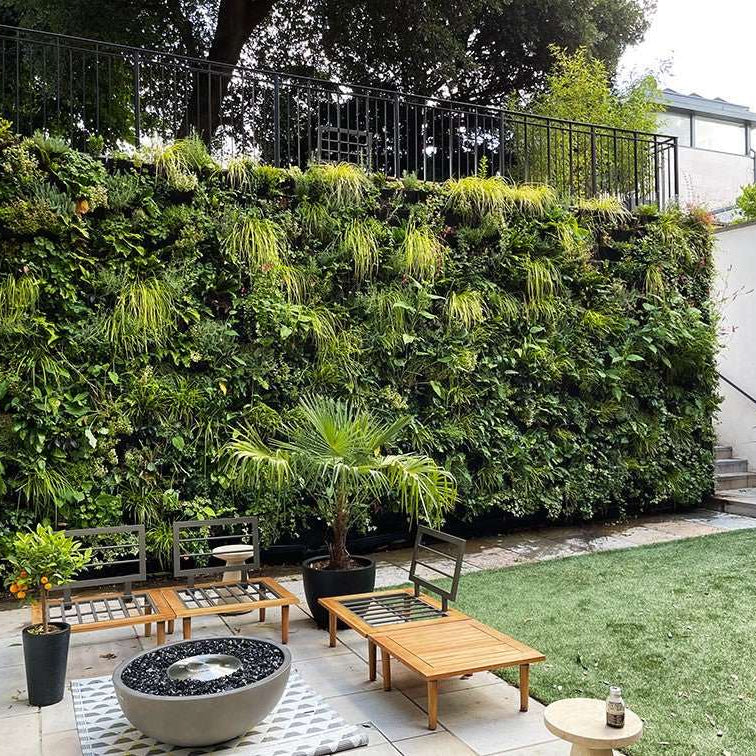



Climate resilience is usually discussed in terms of infrastructure: flood defences, drainage networks, energy systems built to withstand storms. All of that matters. But there is a quieter form of climate infrastructure that rarely gets counted the same way: trees, soil and living systems, from a street tree to a roof garden, a green wall to a rain garden, a mixed native woodland to a rewetted bog.
This is not a page about planting trees as a symbolic gesture. It is about what horticulture, at every scale, demonstrably does when a heatwave hits, when a storm drops more rain than a drainage system was built to handle, or when land is managed in ways that either add to climate risk or help absorb it. That evidence base spans street-level tree planting and building-scale roof and wall greening right through to how we manage forestry and peatlands at a landscape scale, and it is now large, international, and increasingly specific to conditions like Ireland's.
Ireland's own climate is already shifting. Met Éireann's projections point to wetter winters, drier summers and more frequent heat extremes in the decades ahead, while recent years have already brought the kind of storm and flood damage that used to be described as exceptional. The question this page explores is a practical one: what role can horticulture, from the smallest street planter to the largest peatland, play in helping places adapt?
The Challenge
Ireland's climate is changing in ways that are now well documented rather than speculative. Met Éireann's projections indicate that summer rainfall may decrease by roughly 9%, raising the risk of water shortages, while winter rainfall could increase by as much as 24%, raising flood risk. Heat extremes are projected to become more frequent and more intense.
Ireland's second statutory National Adaptation Framework, published in 2024, now requires 13 priority sectors, including the built environment, health and transport, to prepare formal adaptation plans. That framework was informed in part by a study from the ICARUS Climate Change Research Centre at Maynooth University, which found that the extreme rainfall behind the October 2023 flooding, including the flooding in Midleton, County Cork, was around 13% more intense than it would otherwise have been because of climate change.
Much of the national response, understandably, focuses on large-scale infrastructure: flood defences, drainage upgrades, coastal protection. These are essential. But a growing body of research points to a complementary role for something far more distributed and far cheaper to deploy at small scale: trees, soil and green infrastructure woven through the places people already live.
What Does the Evidence Say?
Two climate pressures dominate the research on horticulture and green infrastructure: heat, and heavy rain. The evidence on both is now substantial, drawn from large international studies rather than isolated case studies.
Trees and Urban Heat
Urban heat is one of the most consistently documented risks of a warming climate, and it is also one of the areas where the cooling effect of trees has been most rigorously tested.
For a closer look at how leaf traits and tree species may affect cooling, and why the findings need to be interpreted in local conditions, read Right Plant, Right Place, Right Purpose: Why Ireland Needs Its Own Evidence.
Cooling Efficacy of Urban Trees Across 110 Cities
Wang et al., 2024
Communications Earth & Environment
A global meta-analysis of 182 studies across 17 climate zones and 110 cities found that urban trees can lower pedestrian-level air temperature by up to 12°C, with tree implementation reducing peak monthly temperatures below 26°C in 83% of the cities studied. The researchers found the cooling effect depends on tree traits, urban layout and background climate, but that trees consistently reduce heat exposure at street level.
Tree Canopy and Land Surface Temperature
World Resources Institute, summarising global research
2026
A global study of 806 cities found that increases in tree canopy are associated with midday reductions in land surface temperature of around 1.5°C. A separate global meta-analysis found that each 10% increase in tree canopy cover lowers ambient air temperature by roughly 0.3°C, demonstrating a measurable, dose-dependent relationship between canopy cover and cooling.
Tree Canopy and Heat-Related Health Risk in London
Personal weather station study, 2015 to 2022
Published in a peer-reviewed environmental health journal
Using data from personal weather stations across Greater London combined with official Met Office records, researchers found that areas with the highest tree canopy coverage had average maximum daytime temperatures 0.8°C lower, and minimum temperatures 2.0°C lower, than areas with the least canopy coverage during the 2022 heatwaves. The study used these findings to model the potential for tree canopy to reduce heat-related mortality under future climate scenarios.
Cooling Effect of Urban Trees: 128 Studies
Published in Theoretical and Applied Climatology, 2025
A systematic review following the PRISMA framework, synthesising 128 eligible studies, found that urban trees reduce air temperature by approximately 0.5 to 5.8°C and surface temperature by 2 to 12°C, depending on canopy density, climate type and measurement method. The review identifies shading and transpiration as the two dominant cooling mechanisms.
A tree does not know it is climate infrastructure. It simply shades a pavement, cools the air around it, and slows the rain on its way to the drain. Multiply that by every street in a town, and the effect stops being small.
Peter Dowdall, The Irish Gardener
Roof Gardens and Green Walls
Street trees are not the only way horticulture reduces heat and manages water in built-up areas. On buildings themselves, green roofs and green walls do a version of the same job, cooling the structure they cover, reducing energy demand, and slowing the rain that falls on them.
Green Roofs and Urban Heat Islands
US Environmental Protection Agency
The surface temperature of green roofs can be up to 31°C lower than conventional roofs, and can reduce nearby air temperatures by up to 11°C. Green roofs can also reduce a building's cooling load by up to 70%. Beyond temperature, green roofs reduce and filter stormwater runoff, a second climate benefit from the same installation.
Green Walls and Urban Cooling
Review of over 647 case studies, published 2025
A systematic review of more than 647 case studies found that green walls can reduce ambient air temperature by up to 8°C in dense, high-rise urban environments, with the strongest effects in narrow street corridors. A separate study found that vegetated walls used alongside green roofs can reduce a building's cooling energy use by between 32% and 100%, depending on the scale of implementation.


A roof garden is usually approved, budgeted and measured as a single thing: a nice-to-have amenity, or a stormwater fix. In practice, one roof garden produces a whole set of independent benefits at once, most of which never appear on the same balance sheet.
What one roof garden might deliver
- Slows and reduces stormwater entering drains and rivers
- Reduces flood risk downstream
- Cools the building in summer, insulates it in winter
- Improves local air quality
- Creates habitat and supports biodiversity
- Supports mental health and wellbeing for those with access to it
- Encourages physical activity, tending and walking
- Reduces noise from the street below
- Extends the working life of the roof itself
- Creates a shared social and recreational space
Ten outcomes. One roof garden. If it reduces flood risk, cuts energy use and supports mental health at the same time, why is it still budgeted as if it only does one of those things?
Green Infrastructure and Heavy Rain
The second major pressure, heavy rainfall and flooding, is where green infrastructure such as rain gardens, permeable paving, swales and soil-based drainage has been most closely studied as an alternative or complement to conventional pipe-and-drain systems.
Flood Loss Avoidance Benefits of Green Infrastructure
US Environmental Protection Agency, modelling study across 20 watersheds
A modelling study conducted with the US Army Corps of Engineers, NOAA and FEMA estimated the flood loss avoidance benefits of applying green stormwater infrastructure practices to new development and redevelopment. The study found that, over time, green infrastructure can save hundreds of millions of dollars in avoided flood losses when applied at scale across watersheds.
Water Retention by Green Infrastructure
Published in a peer-reviewed water management journal, 2025
A meta-analysis reviewing green roofs, pervious pavements, bioretention systems, vegetative swales and infiltration trenches found that these green infrastructure types consistently retain and slow stormwater runoff, reducing the volume and speed of water reaching drainage systems during heavy rainfall. The review notes that runoff retention performance decreases as rainfall totals increase, meaning green infrastructure works best as one part of a wider flood management strategy rather than a complete replacement for it.
Taken together, this evidence points to the same conclusion from two different directions. Trees and soil-based green infrastructure will not replace the flood defences, drainage upgrades and engineered systems that large-scale climate adaptation requires. But they are a tested, evidence-backed contributor, one that happens to be smaller in scale, more distributed, and often considerably cheaper to deploy street by street and building by building than major infrastructure projects.
Beyond Streets and Gardens: Forests and Peatlands
Everything above operates at the scale of a street, a building or a garden. But horticulture's relationship with climate resilience also plays out at a much larger, landscape scale, in how we manage forestry and how we treat peatlands. Both are areas where the choices being made in Ireland right now have a direct bearing on climate resilience.
Forest Composition and Fire Risk
As climate change brings hotter, drier conditions, wildfire risk is rising in places that have not historically had to plan for it, and the type of forest matters to how that risk plays out. A large-scale global study published in Nature Communications in 2025 found that timber plantations in temperate countries are twice as likely to be destroyed by wildfire as natural, more diverse forests under comparable conditions. Even-aged, single-species conifer plantations tend to carry more continuous, densely packed fuel than mixed native woodland, and lack the varied canopy structure that helps slow a fire's spread in a more diverse forest.
This is genuinely debated in Ireland. A significant share of Irish forestry is Sitka spruce plantation, and the forestry sector points to real increases in broadleaf planting in recent decades and to minimum broadleaf requirements now built into planting schemes. Environmental groups and some ecologists argue the pace and scale of that shift remains far too slow relative to the climate and biodiversity case for native, mixed woodland. Both positions draw on real data. What the international wildfire research adds to that debate is a specific, evidence-based reason, beyond biodiversity alone, to weight future planting more heavily toward native, mixed-species woodland rather than single-species conifer plantation.
Rewetting Peatlands
Ireland's bogs are a distinctive part of this picture, and a distinctive part of the argument for horticulture and land management as climate infrastructure. Drained and degraded peatland does not sit neutrally, it actively emits carbon. Rewetting reverses that, and Ireland now has a live, large-scale programme doing exactly that.
Bord na Móna Peatlands Climate Action Scheme
Funded in part by €108 million from the EU Recovery and Resilience Facility
Bord na Móna's rewetting programme targets around 33,000 hectares of former industrial peatland across 82 bogs in the midlands, with over 18,000 hectares rehabilitated by the end of 2024. The scheme is projected to protect the storage of some 100 million tonnes of carbon, while degraded, undrained Irish peatland has been estimated to emit in the region of 21.6 million tonnes of CO2 equivalent per year, comparable to the annual emissions of Ireland's entire transport sector.
The co-benefits go beyond carbon. Restored bogs are already showing biodiversity gains, including species returning to sites after long absences, and some rehabilitated peatlands, such as Lough Boora Parklands in County Offaly, have become recreation and tourism destinations in their own right. A single rewetting project can be reducing carbon emissions, restoring habitat and creating a visitor amenity from one piece of land, which is the same multiplier pattern that runs through every other example on this page.
This Is Already Happening
As with the other pages in this series, the case for horticulture's role in climate resilience is not only a research question. It is already visible in the organisations and programmes working on it in Ireland today.
If you're writing about climate adaptation, green infrastructure or trees, Peter is available for comment, quotes or interviews.
Media & Speaking →If you work in public health, education, local authority or community development, and want to explore what horticulture could contribute, get in touch.
Get In Touch →The Tree Council of Ireland
Founded in 1985, the Tree Council of Ireland is the umbrella body linking around 50 organisations connected by their interest in trees, working with businesses, local authorities, government departments and community groups to deliver tree planting and conservation across the country. Its National Tree Week and National Tree Day initiatives, run in partnership with Coillte and reaching schools nationwide, are among the largest tree-focused public engagement efforts in the country. Increasing tree cover, one of the clearest levers identified in the research above, is precisely the kind of distributed, everyday action this kind of organisation exists to encourage.
National and Local Flood Adaptation Planning
Ireland's National Adaptation Framework, overseen by the Department of Climate, Energy and the Environment with the Office of Public Works, Met Éireann and the Environmental Protection Agency all playing formal roles, now requires local authorities to build climate resilience into planning and zoning decisions. Flood risk management, one of the framework's priority sectors, increasingly looks beyond hard engineering toward nature-based and green infrastructure approaches as part of a wider toolkit, consistent with the international evidence on green infrastructure's role in reducing flood risk.
Urban Greening in Irish Towns and Cities
Across Irish towns and cities, tree planting, urban greening and sustainable drainage are increasingly appearing in local authority development plans, not as decorative additions but as functional responses to heat and flood risk. This reflects the same shift visible internationally: green infrastructure moving from an amenity consideration to a recognised adaptation tool.
Cork City Council's greening pilot on St Patrick's Street is a live, local example of exactly this shift: mature tree canopy and diverse planting designed into the city's main street, in part to provide shade and slow rainfall in a heavily paved commercial area.
Read the Patrick Street case study →
"Climate adaptation is usually planned at the scale of infrastructure. Trees work at the scale of a street, and that is exactly why they matter.
Peter Dowdall, The Irish Gardener
Four Ways Horticulture Supports Climate Resilience
Reducing Heat Exposure
Street trees, roof gardens and green walls all cool the air and surfaces around them through shading and transpiration, with research showing measurable temperature reductions at pedestrian level and on buildings themselves. As heatwaves become more frequent, this is a direct, tested contribution to public health and comfort.
Managing Heavy Rain
Soil, trees, rain gardens, permeable surfaces and green walls slow and absorb rainfall before it reaches drainage systems, reducing pressure on infrastructure during the kind of intense rainfall events becoming more common in Ireland.
Shaping Landscape-Scale Risk
How forestry and peatland are managed affects climate resilience at a much larger scale than any single street or garden. Native, mixed woodland and rewetted bogs both carry a stronger climate case than the alternatives they typically replace.
Working Alongside Engineered Infrastructure
None of this replaces flood defences, drainage upgrades or large-scale climate adaptation planning. The evidence supports horticulture as a complementary layer, distributed across streets, buildings and landscapes rather than concentrated in a small number of large projects.
One reason climate resilience fits naturally within the wider argument of this series is that the same tree doing the cooling and drainage work described above is very rarely doing only that. A street tree that reduces heat and slows rainfall is very often the same tree supporting biodiversity, improving how a street looks and feels, and encouraging people to spend time outdoors. Climate resilience is rarely funded, planned or measured alongside those other outcomes, even though the same intervention is producing all of them at once.
Looking Ahead
Climate adaptation in Ireland is, rightly, being built around large infrastructure: flood defences, drainage capacity, coastal protection, energy resilience. Horticulture is not a substitute for any of that. The purpose of this page has not been to suggest otherwise.
What the evidence does suggest is that horticulture, at every scale from a roof garden to a rewetted bog, is a tested, quantifiable, and often comparatively low-cost contributor to the same goals, one that works at a different scale to major infrastructure and can be deployed alongside it.
- Measurable reductions in street-level, building-level and neighbourhood heat
- Reduced and slowed stormwater runoff during heavy rainfall
- A stronger climate and fire-resilience case for native, mixed woodland over single-species conifer plantation
- Significant, quantified carbon benefits from peatland rewetting, alongside biodiversity and recreation gains
- A complement to, not a replacement for, engineered flood and drainage infrastructure
Climate resilience is only one part of the Beyond Gardens story. The same tree, the same green space, is very often doing this work alongside supporting mental health and wellbeing, physical health, food security and biodiversity, often from a single intervention and a single budget line. The wider challenge is not simply understanding what horticulture is. It is understanding what horticulture can help us achieve.