



This week Cork hosted mayors, public-health leaders and city officials from across Europe for the WHO Summit of Mayors on Climate and Health, culminating in more than 100 city leaders from 60 cities and 22 countries signing the Cork Call to Action on Climate and Health.
Seeing Cork host the Summit felt particularly significant to me. My grandmother was the first woman to serve as Lord Mayor of Cork, and I couldn't help wondering what she would have made of Cork hosting mayors from across Europe nearly seventy years later to discuss the health, climate and future of our cities.
But the question I keep coming back to is a practical one.
What does Cork do now?
The agenda is already set
This is no longer simply about persuading people of the importance of greener cities. Cities are no longer being asked simply to aspire. European policy is increasingly requiring action.
Under Article 8 of the EU Nature Restoration Regulation, there can be no net loss in the total national area of urban green space or urban tree canopy cover in urban ecosystem areas by the end of 2030, compared with 2024. From 2031, Member States must then ensure an increasing trend in urban green space until a satisfactory level is reached.
Much of the practical challenge of delivering that ambition will thus play out in our cities and towns.
The groundwork is in place
The Summit was framed around a simple idea: the systems that shape daily life, from transport and housing to food, green and blue space and emergency preparedness, are also where some of the biggest health and climate gains sit.
Its stated aim was to move, in the Irish Presidency's words, from what needs to be done to how it will be delivered. Cork City Council said the event would showcase how city leadership can translate policy recommendations and scientific evidence into "practical, community-centred solutions that improve health and wellbeing".
The programme backed that up with practice. Day 2 included hands-on workshops on moving from data to action with the Lancet Countdown indicators, on assessing places with the Place Standard Tool's Climate Lens, and on the My Green Space Tool.
The Cork Call to Action makes the next challenge even clearer. More than 100 city leaders have now signed up to commitments on nature, food, active travel, housing and climate resilience. The question is how those commitments are turned into action on the ground.
Cork City Council's own description of what successful implementation requires identifies integrated governance, reliable data, meaningful community participation and shared accountability, alongside measurable action, shared learning and continuous improvement.
So, the Summit has strengthened the diagnosis, gathered the evidence and expertise, and begun exploring the tools. The question I am interested in now is how we bring those ingredients together around real places.
These are questions I have been working through for some time through my Beyond Gardens work. I have been looking at how horticulture and living systems can contribute not just to greener places, but to health, biodiversity, climate resilience, food, community and the quality of the places in which we live and, increasingly, at the harder question of how those benefits can actually be delivered, measured and communicated.
What was being discussed at the Summit was many of those same questions.
From ambition to a mechanism
For me, the real question now is not whether greener, healthier and more nature-positive cities are necessary. We know they are. We already have a substantial evidence base for that, European policy is increasingly requiring action, and the Summit has reinforced the connections between climate, health, nature and place.
The real, but harder, question is: if much of this is already understood, why is it still not happening and why is it so difficult to deliver at the scale required?
Part of the answer, I believe, is that we may understand the individual pieces without yet having an effective mechanism for bringing them together around a particular place.
Cork is already thinking across these boundaries. The Summit programme described the city's Healthy Cities approach as "whole-of-system", connecting people, place, participation, planet, prosperity, peace and preparedness, while Cork neighbourhoods were presented as a "living laboratory" for climate and health action.
The opportunity now, as I see it, is to turn that thinking into a practical and repeatable way of working at project level.
That is the gap I think Cork now has an opportunity to explore.
The Summit and the Cork Call to Action have brought those questions into sharper focus and, building on the work I have already been developing through Beyond Gardens, I believe Cork now has an opportunity to test a practical implementation model for nature and health.
My proposal is a small, funded, cross-sector programme that would take a handful of real places, identify what we want them to deliver, bring the necessary expertise together from the beginning, test what works, measure what we reasonably can and develop a model that can be repeated elsewhere.
These demonstrator projects are the tests; the real objective is the model.
That would make the demonstrators a practical way of doing what the Cork framework itself is calling for: bringing different sectors together, using evidence and data, involving communities, creating accountability, measuring action and learning from what happens.
Rather than assuming that greening automatically delivers a standard set of benefits, Cork could begin generating its own evidence about what works, where, for whom and under what conditions.
We don't need random greening and, in fact, I think that this is perhaps the real reason that it has not yet happened at scale: it is because of the lack of joined-up thinking.
A project lands, very few people knew about it in advance, with many of the people who could contribute to its wider value brought in too late, if at all. Benefits are hoped for, but not identified in advance or monitored to see if these benefits are achieved, and the result is often a nice patch of plants and flowers whose only clearly demonstrable outcome is that the space looks better.
There is nothing wrong with making a place more attractive, but if the same investment could also have been designed to deliver measurable benefits for health, biodiversity, climate resilience, water management or community, we have missed an opportunity.

Each project should be designed, before a spade goes in the ground, with clear answers to:
1. What problem are we trying to solve in this particular place?
2. Which outcomes could realistically be delivered here?
3. What evidence supports those expectations?
4. What baseline information do we need before intervention?
5. Which disciplines need to be involved from the beginning?
6. What will we measure, how and for how long?
7. Who benefits, and does that tell us something about who should contribute to funding it?
8. Who will maintain it, what will that cost, and who carries that responsibility over its lifetime?
9. How will communities be involved?
10. How will the results be communicated to the public and decision-makers?
11. What happens if the evidence tells us an intervention isn't working as intended?
12. Finally, what have we learned that can be replicated elsewhere?
We shouldn't green first and look for benefits afterwards.
We should identify the benefits we want, design for them, bring in the right expertise, and then measure whether we actually delivered them.
FROM AMBITION TO ACTION
A proposed model for Cork
Developed through Beyond Gardens
Why does this design discipline matter?
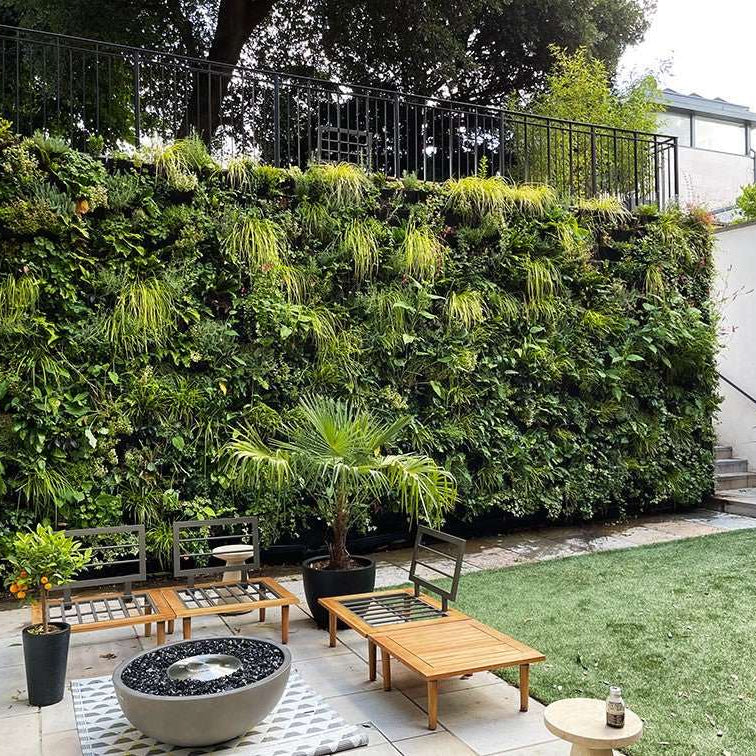
Funding. One well-designed planting intervention can serve several goals at once. I think of this as the Horticulture Multiplier Effect: the right street tree, in the right place, can mean shade, cooler surroundings, rainfall interception, habitat, a more attractive walking environment and a better public realm for businesses.
The benefits land across many budgets while, at the moment, the cost lands on one. As one participant in the Irish Green Building Council's BIO-NEIGHBOUR work put it: "the value is in air quality, natural flood management, transport, health, biodiversity. None of whom pays for it."
That's more than a funding problem; it's an organisational one. The benefits cross sectors, while budgets and responsibilities stay inside one sector. A well-designed demonstrator project could begin to show where that value is created, who benefits from it and, potentially, who should contribute to delivering it.
Dan Boyle, former Lord Mayor of Cork, invoked the Irish tradition of meitheal during the Summit, collective effort towards a shared goal. He also argued that if there is one message to come from the Cork Call to Action, it should be that it can be done.
Those two thoughts belong together.
If the outcomes we want cross health, environment, transport, planning, community and other areas, then implementation cannot depend on one sector working harder on its own. It requires different sectors bringing their expertise, resources and responsibilities together around the same places and the same outcomes.
In other words, a modern meitheal for healthier, greener places.
Maintenance. Maintenance costs are visible, though the value they protect usually isn't immediately. The right comparison is not maintenance versus no maintenance. It is the whole-life cost and value of a green solution against the alternative, which is sometimes grey infrastructure that may cost more and may do less.
Public support. A scheme can be excellent for biodiversity, stormwater and air quality and still fail politically. People may not give up a parking space for biodiversity, but they may give it up for a street that looks more beautiful and on which they prefer spending more time.
Good horticulture, with flowers and seasonal interest, is not decoration added after the serious work. It is often what makes the serious work deliverable.
A city can choose to organise this way
One example brought directly to the Summit was Lahti in Finland, represented by Milla Bruneau, First Vice Chair of Lahti City Council.
Since 2022, Lahti has integrated health and environmental goals through its ten-year Nature Steps to Health programme, which treats people's wellbeing and the state of the environment as one whole.
Lahti's experience is particularly relevant because it demonstrates the principle at the heart of this argument: different outcomes can be pursued deliberately together. As Bruneau has explained in relation to mobility, at their best, solutions can simultaneously benefit health, climate and the everyday lives of city residents.
The lesson is that integration can be organised deliberately, rather than discovered as a happy overlap after the fact.
Where horticulture fits
A programme like this needs ecologists, engineers, economists, planners, community expertise and public-health specialists.
Horticulture belongs at that table too.
It doesn't replace any of them, but planting is where many of these outcomes are ultimately won or lost, in species choice, soil, establishment, management and the years of care that follow. It's also usually the part that people see, experience and judge.
Communication belongs there from the beginning too.
If communities are going to support change, people need to understand what is being done, why it is being done and what it is intended to achieve. And if demonstrator projects are going to influence what happens elsewhere, their results, successes as well as shortcomings, need to be translated into something that the public, policymakers and those funding future projects can understand and use.
The Summit has strengthened the diagnosis, assembled expertise and explored some of the tools. The Cork Call to Action has now established the political commitment.
The next challenge is implementation.
Cork's opportunity is to build a practical mechanism that brings integrated governance, evidence, participation, accountability, measurement and shared learning together around real places.
Dan Boyle's contribution perhaps offers the simplest message for what comes next: it can be done. The question now is how.
The Summit set out to move the conversation from what needs to be done to how it will be delivered.
Cork now has an opportunity to answer that question in practice.
Beyond Gardens
This article forms part of Peter Dowdall's Beyond Gardens work, exploring how horticulture and living systems can contribute to healthier people, healthier communities and healthier places.
About Peter Dowdall
Peter Dowdall is a horticulturist, planting designer and broadcaster. Through Beyond Gardens, he is exploring the wider role horticulture and living systems can play in health, biodiversity, climate resilience, food, community and the quality of the places in which we live.